
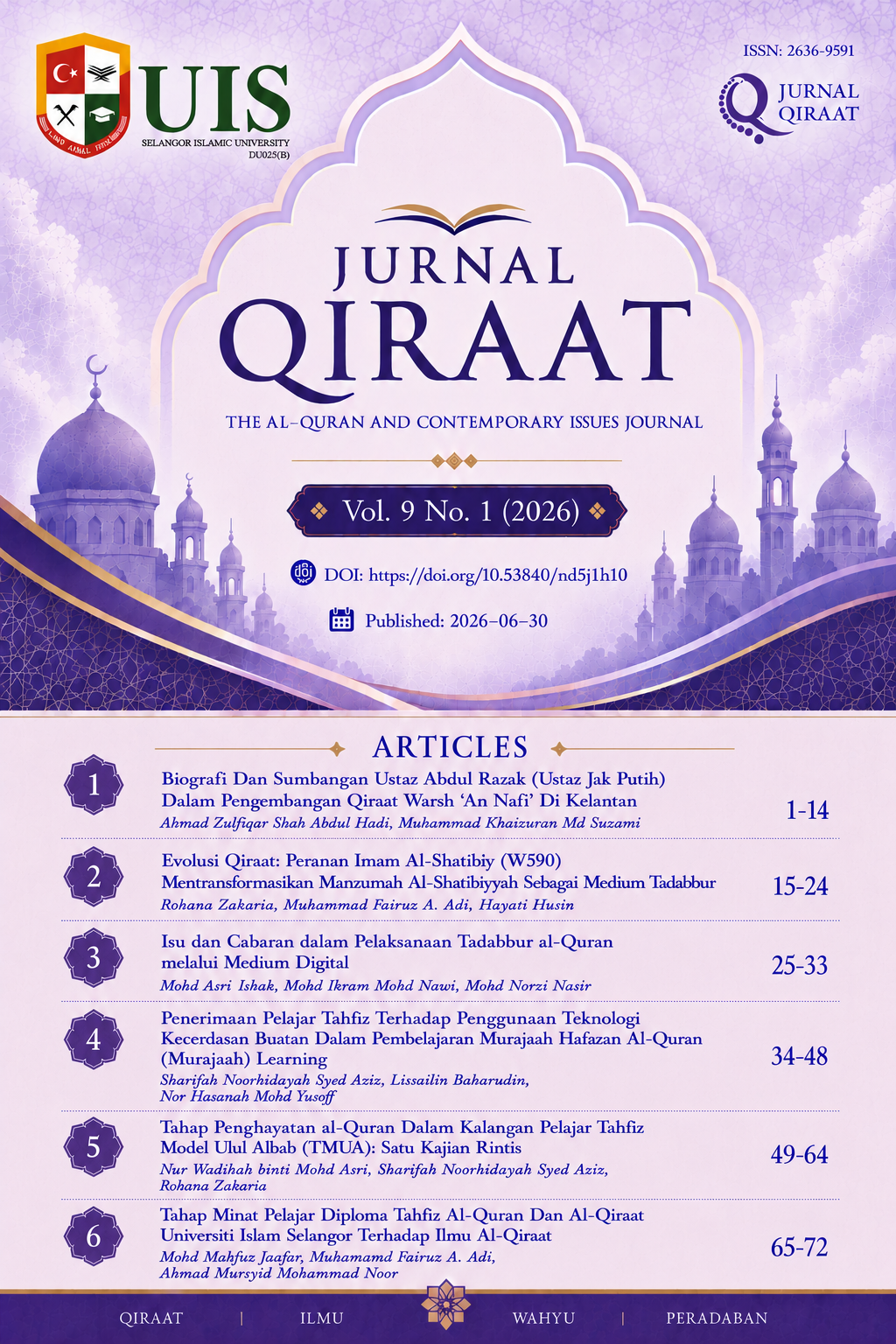
Penerimaan Pelajar Tahfiz Terhadap Penggunaan Teknologi Kecerdasan Buatan Dalam Pembelajaran Murajaah Hafazan Al-Quran
Acceptance of Artificial Intelligence Technology among Tahfiz Students in Quranic Memorisation Revision (Murajaah) Learning
DOI:
https://doi.org/10.53840/deg4yt92Keywords:
artificial intelligence technology, murajaah, Quranic memorisation;Abstract
The advancement of digital technology has led to changes in learning approaches across various fields, including Quranic Tahfiz education. Artificial intelligence technology does not entirely replace conventional learning methods; rather, it has the potential to support the process of murajaah (revision) in Quranic memorisation. Among the artificial intelligence technologies utilised are recitation recognition applications, tajwid error analysis, verse repetition recommendations, and memorisation progress monitoring. Accordingly, this study examines the level of acceptance among Tahfiz students towards the use of artificial intelligence technology in murajaah learning of Quranic memorisation. This study employed a quantitative research design using a survey approach. Research data were collected through questionnaires distributed to 120 Tahfiz students. The questionnaire examined several aspects related to memorisation learning, including perceptions of ease of use, the implementation of artificial intelligence technology in learning, interest in technology usage, and students’ readiness to utilise artificial intelligence applications in the murajaah process. The data were analysed descriptively using SPSS version 27.0. The findings indicate that the majority of students demonstrated positive acceptance towards the use of artificial intelligence technology. Artificial intelligence was found to support the murajaah process, facilitate recitation review, and increase memorisation motivation. This study provides an indication that the integration of artificial intelligence technology in Tahfiz education is compatible with the learning needs of contemporary Quran memorisation students.
Downloads
References
Azri, N. H. I., Mohd Azmi, N. F., & Syed Hassan, S. N. (2023). Penguasaan amalan murajaah al-Qur’an dalam kalangan pelajar Fakulti Pengajian Quran dan Sunnah, USIM. Jurnal Penyelidikan Islam dan Kontemporari (JOIRC), 6(11), 132–145. https://doi.org/10.55573/JOIRC.061112
Che Mat, A., Wan Adnan, W. A. S., Awang, A., & Wan Jusoh, W. N. H. (2020). Tahap amalan kaedah hafazan al-Quran dalam kalangan pelajar program al-Quran IMTIAZ. E-Journal of Islamic Thought & Understanding (E-JITU), 3(1), 57–72. https://doi.org/10.24191/ejitu.v3i1
Hawari, M. I. L., Shauki, M. I. M., Shakhruddin, M. S., & Hassan, S. N. S. (2023). Analisis kaedah pengajaran hafazan dan murajaah Al-Quran secara atas talian sepanjang era pandemik di Maahad Tahfiz Al-Quran Wal Qiraat Pulai Chondong Machang Kelantan. E-Prosiding Konvensyen Kearifan Nusantara Ke-4 (ARIF 2023), Universiti Sains Islam Malaysia
Kadir, M. N. A., & Huda, M. (2025). Pencapaian muraja’ah hafazan al-Qur’an pelajar TVET-Tahfiz MARA ketika menjalani latihan industri. Al-Makrifah Journal of Knowledge and Learning in Islamic Tradition and Culture, 3(1), 54–65. https://doi.org/10.37134/almakrifah.vol3.1.5.2025
Maidin, N. ‘A. S. H., Omar, A. H. B. H. A., Mokhtar, A. B. H. B. H., & Hashim, N. A. A. B. H. M. (2025). Development of an AI-based smart device for Quran memorization using spaced repetition technique. International Journal of Innovative Science and Research Technology, 10(10), 966–969. https://doi.org/10.38124/ijisrt/25oct691
Naufal, A. G., Dahliana, Y., & Prasetyo, A. (2024). The role of the Tarteel application in maintaining the memorization of Al-Qur’an memorizers. AL-WIJDÃN Journal of Islamic Education Studies, 9(4), 666–680. https://doi.org/10.58788/alwijdn.v9i4.5640
Nigar, N., Wajid, A., Ajagbe, S. A., & Adigun, M. O. (2023). An intelligent framework based on deep learning for online Quran learning during pandemic. Applied Computational Intelligence and Soft Computing, 2023, Article 5541699. https://doi.org/10.1155/2023/5541699
Rahim, M. M. A., Borham, A. H., Faisal, N. F., & Sulaiman, S. (2025). Penguasaan murajaah hafazan al-Quran dan ekosistem pembelajaran tahfiz. QIRAAT: Jurnal Al-Quran dan Isu-Isu Kontemporari, 8(2), 1–14. https://doi.org/10.53840/jq.v8i2.129
Salihin, M. S., Hashim, I. Z., Hanafi, N. M. N. N., Mansor, F. N., & Mahir, M. A. (2018). Penghayatan muraja’ah al-Qur’an dalam kalangan pelajar tahfiz al-Qur’an dan al-Qiraat Kolej Universiti Islam Antarabangsa Selangor (KUIS). In Proceedings of the 5th International Research Management & Innovation Conference (IRMIC 2018), Kolej Universiti Islam Antarabangsa Selangor.
Sukmawati, A. (2024). Pemanfaatan artificial intelligence untuk meningkatkan efisiensi pembelajaran Al-Qur’an. Dinamika Penelitian: Media Komunikasi Penelitian Sosial Keagamaan, 24(1), 53–72. https://doi.org/10.21274/dinamika.2024.24.01.53-72
Syed Aziz, S. N., Baharudin, L., & Syahirah, N. I. (2024). Perbandingan sikap pelajar terhadap hafazan al-Qur’an: Kajian di Sekolah Menengah Kebangsaan Agama Putrajaya. QIRAAT: Jurnal Al-Qur’an dan Isu-Isu Kontemporari, 7(1), 10–18. https://doi.org/10.53840/qiraat.v7i1.73.
Syed Aziz, S. N., Mohd Asri, N. W., & Baharudin, L. (2025). Peranan teknologi kecerdasan buatan (AI) dalam pengajaran dan pembelajaran al-Qur’an & al-Qiraat. QIRAAT: Jurnal Al-Qur’an dan Isu-Isu Kontemporari, 8(2), 26–37. https://doi.org/10.53840/qiraat.v8i2.105
Yusof, N. H., Mat Idris, M. F. H., Abd Hamid, F. Z., & Ali, M. Z. (2022). Pembinaan modul pintar murajaah al-Qur’an di institusi pengajian tahfiz Malaysia. BITARA International Journal of Civilizational Studies and Human Sciences, 5(3), 94–105. https://doi.org/10.37134/bitara.vol15.1.4.2022
Zakaria, M. S., & Abu Samah, N. A. (2022). Model hafazan al-Qur’an Techno Huffaz. Politeknik Sultan Salahuddin Abdul Aziz Shah.
Downloads
Published
Issue
Section
License
Copyright (c) 2026 Sharifah Noorhidayah Syed Aziz, Lissailin Baharudin, Nor Hasanah Mohd Yusoff

This work is licensed under a Creative Commons Attribution-NonCommercial 4.0 International License.


