
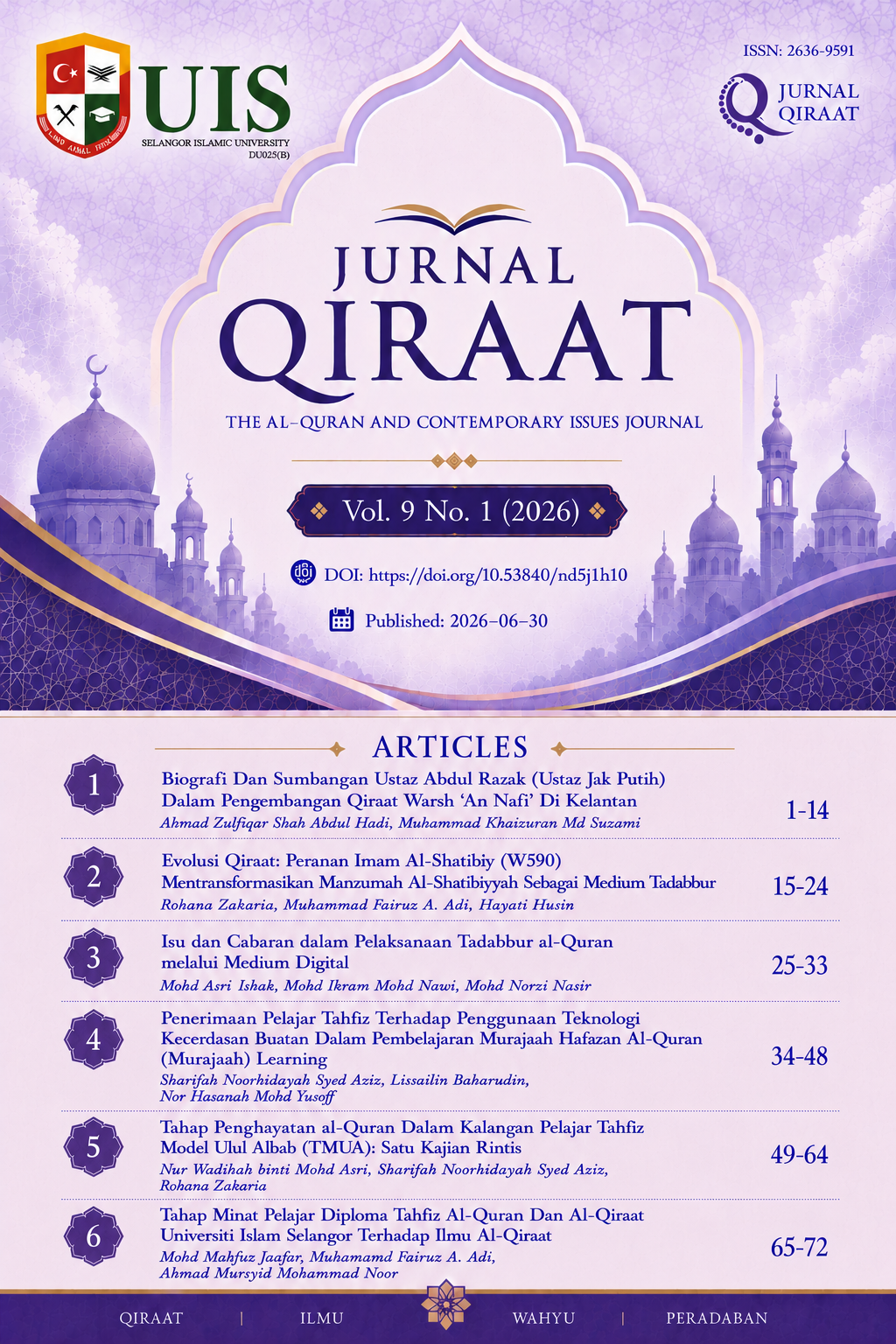
Peranan Imam Al-Shatibiy (W590) Mentransformasikan Manzumah Al-Shatibiyyah Sebagai Medium Tadabbur
The Role of Imam Al-Shatibiy (W590H) in Transforming Manzumah Al-Shatibiyyah as a Medium Tadabbur
DOI:
https://doi.org/10.53840/y8465m02Keywords:
Tadabbur Qiraat, Ilmu Qiraat , Imam Shatibiy , Inovasi PendidikanAbstract
The mastery of the science of Qira’at is often perceived as complex and exclusive due to the difficulty of memorizing voluminous classical texts. This often results in students focusing strictly on the technicalities of recitation while neglecting the aspect of tadabbur (contemplation of meaning). Consequently, this study aims to analyze the role of Imam al-Shatibiy in revolutionizing the methodology of Qira’at studies through his work, Manzumah al-Shatibiyyah, and to examine how this innovation serves as a catalyst for the practice of tadabbur. This research employs a qualitative approach through content analysis of the text Hirz al-Amani wa Wajh at-Tahani, along with authoritative commentaries (syarah), to investigate the effectiveness of the introduced codification system.The findings indicate that Imam Al-Shatibiy’s transformation specifically through the use of symbolic systems (rumuz) and poetic summaries not only succeeded in simplifying the memorization of Qira’at rules but also significantly reduced the cognitive load on students. This, in turn, creates mental space to explore the diverse dimensions of meaning behind the various recitation modes. Finally, this study advocates for the Manzumah al-Shatibiyyah to be revitalized not merely as a memorization manual, but as an instrument of knowledge integration to produce a Quranic generation that is both proficient in narration (riwayat) and profound in contemplation.
Keywords: Science of Qira’at, Imam al-Shatibiy, Manzumah al-Shatibiyyah, Quranic Tadabbur, Educational Innovation.
Downloads
References
Abu Shamah al-Maqdisi, Abd al-Rahman bin Isma‘il (1982). Ibraz al-Ma‘ani min Hirz al-Amani. Beirut: Dar al-Kutub al-Ilmiyyah. hlm. 42.
Ahmed Alruwaythi.(2025). Poetic Didactic Texts in Qur’anic Readings (Qirāʾāt): Their Origins and Types. International Journal of Educational Sciences and Arts, London Vol (4), No (12), 2025. E-ISSN 2976-7237. https://doi.org/10.59992/IJESA.2025.v4n12p3.
Al-Dhahabi, Muhammad bin Ahmad. (2003). Ma’rifah al-Qurra al-Kibâr al-Tabaqât wa al-A’shar, Riyadh: Dâr al-’Alam al-Kutub.
Al-Dhahabi, Shams al-Din Muhammad bin Ahmad. (1985). Siyar A‘lam al-Nubala’. Tahqiq: Syuaib al-Arna’ut. Beirut: Muassasah al-Risalah. Jil. 21, hlm. 261.
Al-Qadi, Abd al-Fattah. (Tt). Al-Wafi fi Sharh al-Shatibiyyah fi al-Qira’at al-Sab‘.Kaherah: Maktabah al-Jala’. hlm. 5-7.
Al-Qaisi, Makki bin Abi Talib. (1960). Al-Ibanah 'an Ma'ani al-Qira'at. Tahqiq: Abdul Fatah Ismail Shalabi. Kaherah: Dar al-Nahdah Misr.
Al-Qastallani, Ahmad bin Muhammad. (1972). Latā’if al-Ishārāt li-Funūn al-Qirā’āt. Tahqiq: Amir al-Sayyid 'Uthman. 2 Jilid. Kaherah: al-Majlis al-A‘la li al-Shu’un al-Islamiyyah.
Fakhrie Hanif. (2015). Perbedaan Bacaan Dalam Pembelajaran Ilmu Tajwid Menurut Thariq Al-Shatibiy Dan Ibn Al-Jazari Pada Qira’at ‘Ashim Riwayat Hafs. Issn: 2088-4095. Tarbiyah Islamiyah, Volume 5, Nomor 1, Januari-Juni 2015.
Haaland, R. (2004). Technology, transformation and symbolism: ethnographic perspectives on European iron working. Norwegian Archaeological Review, 37(1), 1–19. https://doi.org/10.1080/00293650410001207.
Ibn al-Jazari, Shams al-Din Muhammad bin Muhammad. 1998. Munjid al-Muqri’in wa Murshid al-Talibin. Tahqiq: Ali bin Muhammad al-Umran. Makkah: Dar al-Alam al-Fawa’id.
Ibn Khallikan, Abu al-Abbas Ahmad bin Muhammad. (1972. Wafayat al-A‘yan wa Anba’ Abna’ al-Zaman. Tahqiq: Ihsan Abbas. Beirut: Dar Sadir. Jil. 4, hlm. 72.
Khoirul Muhtadin, Mohammad Iqbal Muadzin, Suhairi. (2024).Teknik Identifikasi Cepat Qira’at ‘Asyr (Analisis Infiradat alQurra’ atau Keunikan Bacaan Imam dan Rawi). Al-Fahmu: Jurnal Ilmu Al-Qur’an dan Tafsir. Volume 3 No. 1, 2024: 64-72. E-ISSN: 2962-9314 | P-ISSN: 2964-1659. https://doi.org/10.58363/alfahmu.v3i1.189.
Muhammad bin Muhammad Ibn al-Jazari. (2006). Ghayah al-Nihâyah fi Tabaqât al-Qurra, (Beirut: Dâr al-Kutub al- ‘Ilmiyyah, h. 20.
Muhammad Ripin dan Miftakhul Huda (2005). The Implementation of Arabic Poetry in Quran Memorization Learning Al-Wazan: Journal of Arabic Education, Vol.3, No.1 2025.
Saud, M., & Shabeeb, T. (2025). Semantic Dimensions in the Diversity of Qur’anic Readings: A Classificatory Analytical Approach. https://www.dragoman-journal.org, 22, 506-518. Antwerp: ATI. DOI: https: //doi.org/10.63132/ati.2025.semant.9262.
Shihâb al-Dîn Ahmad bin Muhammad al-Qastalâni. (2000). al-Fath al-Mawâhib fî Tarjamah al-Imâm Al-Syathibi, Amman: Dâr al-Fath, h. 34.
Wan Nor Atikah Che Wan Mohd Rozali, Ismarulyusda Ishak, Arimi Fitri Mat Ludin, Farah Wahida Ibrahim, Nor Malia Abd Warif and Nur Aishah Che Roos. (2022). The Impact of Listening to, Reciting, or Memorizing the Quran on Physical and Mental Health of Muslims: Evidence from Systematic Review. International Journal of Public Health REVIEW published: 31 August 2022 doi: 10.3389/ijph.2022.16049.
Zamroni Ishaq dan Ihsan Hamid. (2021). Konsep dan Metode Tadabbur dalam Al-Qur'an.Ummul Qura: Jurnal Institut Pesantren Sunan Drajat (INSUD) Lamongan. DOI 10.55352/uq.v16i2.535
Downloads
Published
Issue
Section
License
Copyright (c) 2026 Rohana Zakaria, Muhammad Fairuz A. Adi, Hayati Husin

This work is licensed under a Creative Commons Attribution-NonCommercial 4.0 International License.


