
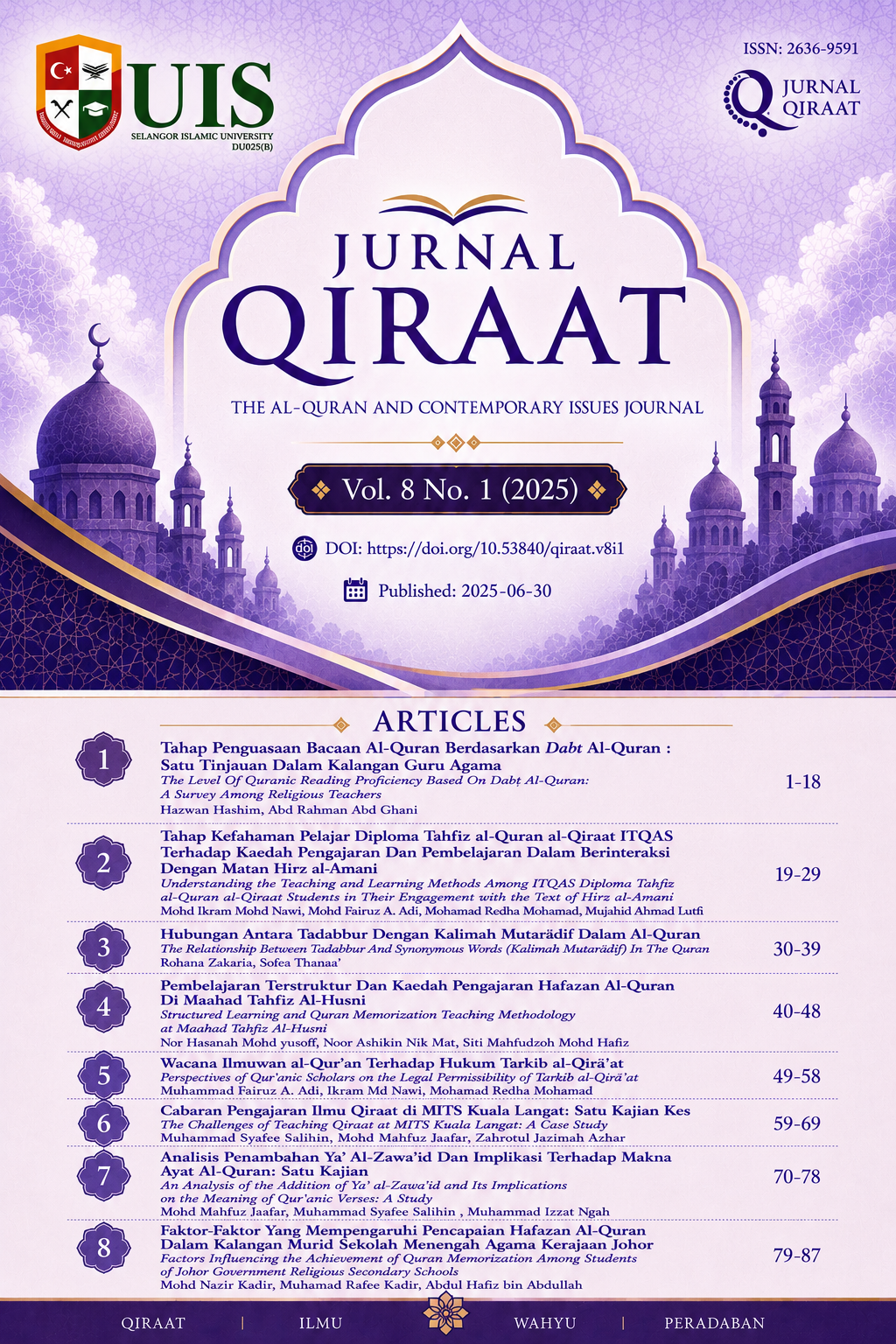
Wacana Ilmuwan al-Qur’an Terhadap Hukum Tarkīb al-Qirā’āt
Perspectives of Qur'anic Scholars on the Legal Permissibility of Tarkīb al-Qirā’āt
DOI:
https://doi.org/10.53840/qiraat.v8i1.96Keywords:
Tarkīb al-qirā’āt, talfīq, jamak qiraat, qiraatAbstract
Tarkīb al-qirā’āt, the practice of combining two or more variations of Qur'anic recitation within a single verse or word, is a significant issue in the field of ‘Ulūm al-Qur’ān (Qur'anic Sciences). This practice has sparked considerable legal discourse among scholars due to the conflict between the principle of diverse recitations and the need to preserve the authenticity of each transmission (riwayah). Accordingly, this study aims to identify the views of scholars and analyze their arguments regarding the permissibility of this practice. The findings show that scholarly opinions are divided into three main categories: (1) those who permit it conditionally, based on the principle that all authentic recitations are divine revelation; (2) those who prohibit it to preserve the integrity of the chain of transmission (sanad) and the discipline of riwayah; and (3) those who adopt a detailed (tafsili) approach, allowing it as long as it does not violate Arabic grammatical structure or alter the meaning of the verse. This tafsili view is seen as a middle path that harmonizes the requirements of transmission with the flexibility of Shari'ah in the practice of recitation. Nevertheless, Muslims are encouraged to continually enhance their knowledge of the discipline and skills of Qur'anic recitation that are customary in their locality, as a means of preserving the Qur'anic transmission and as a form of appreciation for the scholars who have safeguarded the Islamic heritage (turath).
Downloads
References
Al-Bukharī, Muḥammad bin Isma’īl. (t.th). al-Tārīkh al-Kabīr. Haider Abad: Dā’irah al-Ma’ārif Uthmāniyyah.
Al-Hādī Qābah, ‘Abd al-Ḥalīm. (1999). al-Qirā'āt al-Qur'āniyyah, Tārīkhuhā, Thubūtuhā, Ḥujjiyatuhā, Aḥkāmuhā. Beirut: Dar al-Gharb al-Islāmiy.
Al-Sakhawi, A. b. (1999). Jamal al-Qurra' wa Kamal al-Iqra'. Beirut: Muassasah al-Kutub al-Thaqafiyyah.
Al-Suyūtī, J. (2004). Al-Itqān fī ‘Ulūm al-Qur’ān (ed. M. M. al-Khalīl). Dār al-Kutub al-‘Ilmiyyah.
Al-Uqayli, M.Ab. Fattah. (t.th). Hukm Tarkib al-Qiraat. T.tp.
Ibn al-Jazarī. (1998). Al-Nashr fī al-Qirā’āt al-‘Ashr (M. al-Sa‘dī, Ed.). Dār al-Kutub al-‘Ilmiyyah.
Ibn Manẓūr. (1990). Lisān al-‘Arab (Jilid 5). Dar Ṣādir.
Ikmal Zaidi & Syahir Nzly (2022). Aplikasi Qasr al-Munfasil dalam Tilawah al-Quran. In Isu-Isu Kontemporari dalam Pengajian Tahfiz al-Quran dan al-QIraat (pp. 172-177). Selangor: Fakulti Pengajian Peradaban Islam, Universiti Islam Selangor.
Muhammad 'Ali al-Dhabba'. (2007). Sharih al-Nas fi al-Kalimat al-Mukhtalaf fiha 'an Hafs. Tanta: Dar al-Sahabah Li al-Turath.
Salim, M. A. (2022). Qira’ah, Riwayah, Thariq Dan Wajh Dalam Variasi, (Studi Sample Riwayat Hafsh dari Imam Ashim). El-Mu’jam: Jurnal Kajian Al Qur’an dan Al-Hadis, Vol 2. No. 1, 1-13.
Ummi Kalson & Zainora Daud. (2023). Kesignifikan Qiraat Jamak dalam Pengajian Qiraat: Satu Sorotan Literatur. Islamic Science Social Post Graduate Conference 2023 (pp. 82-86). Nilai: Universiti Sains Islam Malaysia (USIM).
Downloads
Published
Issue
Section
License
Copyright (c) 2025 Muhammad Fairuz A. Adi, Ikram Md Nawi, Mohamad Redha Mohamad

This work is licensed under a Creative Commons Attribution-NonCommercial 4.0 International License.


