
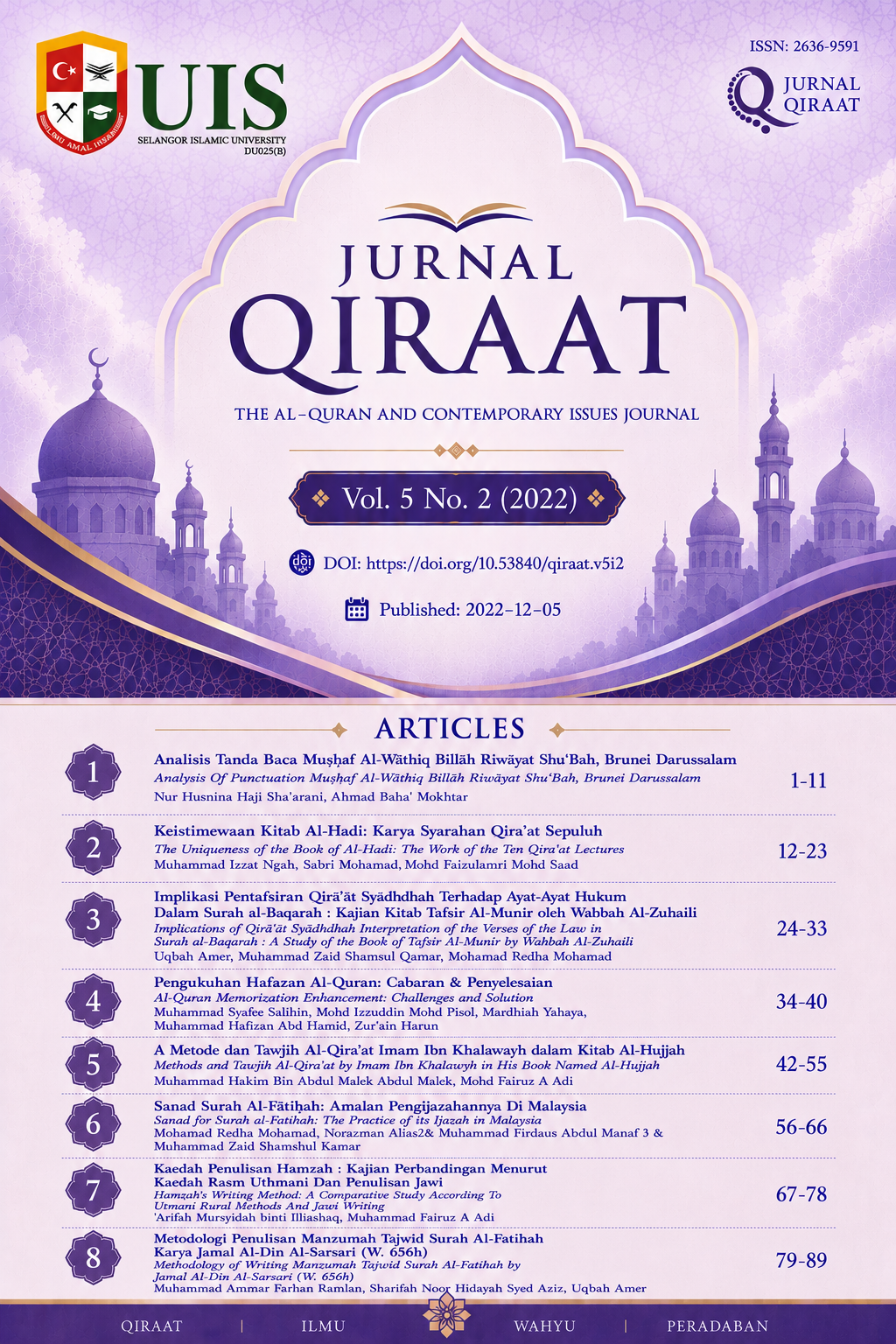
Sanad Surah Al-Fātiḥah: Amalan Pengijazahannya Di Malaysia
Sanad for Surah al-Fatihah: The Practice of its Ijazah in Malaysia
DOI:
https://doi.org/10.53840/qiraat.v5i2.52Keywords:
Sanad, al-Fatihah, Talaqqi, Mushafahah, Qurra’Abstract
The mainstream Islamic community in Malaysia has already began to be exposed by the practice of sanad talaqqī in the context of quranic studies. Nowadays, many people struggled to obtain the Quranic sanad talaqqī. This system is a tradition that has been emphasized by the qurrā’ and began to spread in Malaysia. It is widely known that the Quran has been inherited to and by every generation through reading method known as talaqqī mushāfaḥah. Among the sanad that are spread in Malaysia are the sanad talaqqī 30 juzu’ and the sanad talaqqī al-Fātiḥah. However, society are still less known and understood about the concept of Quranic sanad talaqqī. Therefore, research needs to be done to introduce to the society the practice of the inheritance of Quranic sanad talaqqī in Malaysia. This study will focus on the graduation practice of sanad talaqqī al-Fātiḥah. Data of the study were collected through library documents and sanad talaqqī al-Fātiḥah certificates, while the data analysis method was descriptive. Findings show that there is activity in the graduation of sanad talaqqī al-Fātiḥah in Malaysia but it is not yet widespread. The criteria found on the sanad certificates were also analyzed as a research finding. The implications of this study are important to guide the society in order to build a proper perception towards the graduation of sanad talaqqī al-Fātiḥah. The society needs to be introduced to the practice of Quranic sanad talaqqī in order to produce many individuals who are able to read the Quran fluently and eloquently.
Downloads
References
Alias, N., Mohamad, K. A. & Ahmad, A. M. (2015). Fenomena Talaqqi Al-Quran Bersanad Riwayat Hafs ‘An ‘Asim Menurut Tariq Al-Syatibiyyah: Sumbangannya Dalam Perkembangan Pengajian Al-Quran Di Malaysia. Prosiding Seminar Wahyu Asas Tamadun IV Peringkat Antarabangsa (pp. 169-184). FPQS, USIM.
A’Tarahim, M., Hisham, A., & Shaifulbahri, M., (2009). Perkembangan Awal Ilmu Qiraat. Jurnal Islam dan Masyarakat Kontemporari, 2, 69-79.
Azizul. (2020). Argumentation among Qurra’ Based on Sanad of al-Quran. 10(12). International Journal of Academic Research in Business & Social Sciences. https://hrmars.com/papers_submitted/8220/argumentation-among-qurra-based-on-sanad-of-al-quran.pdf
Fadzil, A. (2018). The Amazing Al-Quran. Kuala Lumpur: Telaga Biru Sdn. Bhd.
al-Jazarī, I. (2002). Ṭayyiba al-Nashr fī Qirā’āt al-‘Ashr. Kaherah: Maktabat al-Sunna.
al-Majidī. (2000). Talaqqī al-Nabī SAW Alfāz al-Qur’ān al-Karīm. Beirut: Muassasa al-Risāla.
Sa’ad, A. (2013). Asānīd al-Qirā’āt wa Manhaj al-Qurra’ fi Dirāsatihā. Riyad: Maktaba al-Malik Fahd al-Waṭanīyyah.
Said, K. & Adam, J. (2011). Corak Tariq Sanad Pengajian Al-Quran Di Negeri Pahang. International Journal on Quranic Research. 1(1). https://ejournal.um.edu.my/index.php/quranica/article/view/5283/3078
Sayyidi, M. (2004). Al-Isnād ‘inda ‘Ulamā’ al-Qirā’āt. Madinah al-Munawwarah: Majalla al-Jāmi‘a al-Islamīyya.
Tawfīq Ḍamrah. (2017). Afḍal al-Hibāt Asānīd al-Musalsalāt.
Zaidar, F. (2014). Faktor-faktor Dorongan Aplikasi Talaqqi Bersanad (TB) Dan Keperluannya Dalam Pengajian Hadis Di Malaysia. Tesis Doktor Falsafah, Universiti Kebangsaan Malaysia, Malaysia.
Zainuddin, K., Zainuddin, N. & Mohd Isa, M. F. (2010). Kamus Pelajar. Negeri Sembilan: Al-Azhar Media Enterprise.
al-Zarqanī. (2001). Manāḥil al-‘Irfān fī ‘Ulūm al-Qur’ān. Kaherah: Dār al-Hadīth.
Downloads
Published
Issue
Section
License
Copyright (c) 2022 Mohamad Redha Mohamad

This work is licensed under a Creative Commons Attribution 4.0 International License.


