
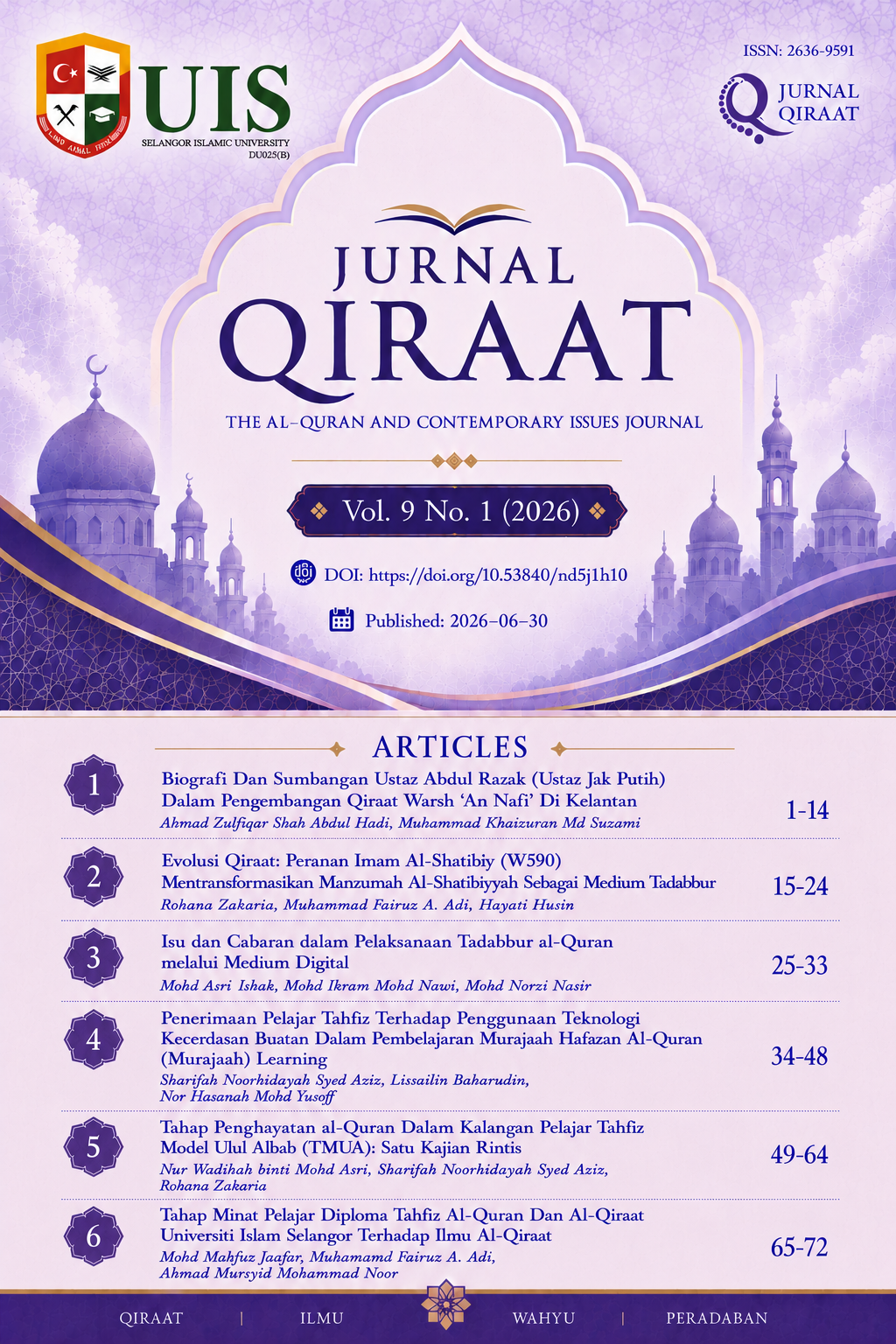
Isu dan Cabaran dalam Pelaksanaan Tadabbur al-Quran melalui Medium Digital
Issues and Challenges in the Implementation of Quranic Tadabbur through Digital Media
DOI:
https://doi.org/10.53840/8wn7yw73Keywords:
Tadabbur al-Quran , Medium DigitalAbstract
The development of digital technology has created new opportunities for the dissemination and appreciation of the Quran, including through tadabur (reflective contemplation) approaches that are more accessible to the public. However, the implementation of Quranic tadabur via digital media also faces various issues and challenges. This study aims to identify the key issues and challenges that arise in efforts to effectively deliver Quranic tadabur through digital platforms. The issues identified include concerns related to the authenticity and authority of sources, limitations in achieving deep tadabur engagement, and the absence of direct teacher guidance (talaqqi). In addition, other challenges involve differences in levels of digital literacy among users, as well as ethical issues and proper etiquette (adab) in interacting with the Quran.This study adopts a qualitative approach through literature analysis and observation of relevant digital platforms such as YouTube, TikTok, Facebook, and others. The findings are expected to provide guidance for preachers, educators, and content developers in strengthening digital approaches to Quranic tadabur so that they are more effective, authentic, and impactful for society.
Keywords:
Quranic, Tadabbur al-Quran, Medium Digital
Downloads
References
Hadi, & Ahmad Zulfiqar Shah. (2025). Al-Quran dalam era kecerdasan buatan (AI): Peluang dan cabaran. Al-Makrifah: Journal of Knowledge and Learning in Islamic Tradition and Culture, Volume (Issue), 84–95.
Ahmad Bazli Ahmad Hilmi, Muhammad Hafiz Saleh, & Adibah Sulaiman @ Mohamad. (2021). Kaedah memahami makna al-Quran dalam pengintegrasian ayat hafazan dengan ilmu aqli. Ulum Islamiyyah, 33, 175–202.
Al-Ghazali. (2005). Ihya' 'ulum al-din. Dar Ibn Hazm.
Al-Momani, I. M. (2025). Ethical challenges for using artificial intelligence in understanding Islam. Salud, Ciencia y Tecnología – Serie de Conferencias,
Althaf Husein Muzakky, Faisal Haitomi, & Maula Sari. (2022). Resepsi tafsir Q.S. Al-Mujadilah di TikTok sebagai upaya edukasi dan pembelaan hak-hak perempuan. Jurnal SMART, (Issue), 1–14.
al-Zarnuji, B. I. (2014). Ta'lim al-muta'allim tariq al-ta'allum (3rd ed.). Dar Ibn Kathir.
Azman Ta'a, Nur Najibah Atiqah Abdul Aziz, Muhammad Shakirin Shaari @ Hj Ashari, Salina Ismail, & Ahmad Suki Che Mohamed Arif. (2023). Al-Quran Tadabbur application for self-learning. Journal of Information System and Technology Management (JISTM), 8(29), 21–35.
Bernama. (2024, May 17). Cabaran media baharu tuntut kemahiran literasi digital.
Dewan Bahasa dan Pustaka. (2015). Kamus Dewan (4th ed.). Dewan Bahasa dan Pustaka.
Elenia, S. (2025). The role of the maqasid approach as a key instrument in Qur'anic tadabbur in the contemporary era. Afkaruna: Indonesian Interdisciplinary Journal of Islamic Studies, 21(1), 136–156.
Hamzah, N. (2022). Study on elements of teacher authority in Islamic online learning (E-Talaqqi). Al-Hayat: Journal of Islamic Education, 6(2), 506–514.
Harahap, N. S. (2023). Implementasi metode talaqqi dalam meningkatkan kualitas hafalan Al-Quran siswa MTs Nurul Falah Panompuan Tapanuli Selatan. Jurnal Islamika, 23(2), 1267–1280.
Hermawan, I. (2023). Tadabur Al-Quran sebagai upaya literasi beragama di era digital. Wahana Karya Ilmiah Pendidikan, 7(1), 1–11.
Indra, H. (2020). Challenges and response in Islamic education perspective in the digital era. Attarbiyah: Journal of Islamic Culture and Education, 5(1), 31–42.
Manan, A., Jannah, N., Lutfi, M., Iffah, N., Anuar, S., Izzah, N., & Syed Hasan, S. N. (2023). Kepentingan dan peranan aplikasi TikTok dalam menyebarkan dakwah di kalangan remaja. In E-Prosiding Konvensyen Kearifan Nusantara Ke-IV (ARIF 2023). Universiti Sains Islam Malaysia.
Fasyani, M. F., Muqsid, A., & Mujtaba, A. W. (2024). Artificial intelligence and digital tafsir: Assessing the interpretive accuracy of ChatGPT's engagement with Tafsir al-Qurtubi. Journal of Ushuluddin and Islamic Studies, Volume (Issue), 86–118.
Mahfudlah Fajrie, et al. (2023). Al-Quran digitalization: Adolescent view on the value of the digital Al-Quran application. Jurnal Komunikasi, 15(1), 92–106.
Manar Muhammad, Muhammad Zaki Sapuan, & Muhammad Haziq Jani. (2025). Etika penggunaan prompt kecerdasan buatan (AI) dalam memelihara kesahihan pegangan Ahli Sunnah Wal Jamaah dalam akidah, fikah dan tasawuf. Journal of Usuluddin, 53(1), 75–98.
Nur Irsalina Amran, Nurul Najihah Kamal, & Syed Najihuddin Syed Hasan. (2024). Pengajian tadabbur al-Quran di aplikasi TikTok. In E-Prosiding Seminar Kearifan Nusantara Kali Ke-5. Universiti Sains Islam Malaysia.
Rohana Zakaria, Mohd Asri Ishak, Sharifah Nurhidayah Syed Aziz, Mardhiah Yahaya, Hayati Hussin, & Sofea Thanaa' Saibon. (2024). Tadabbur al-Quran melalui teknologi maklumat: Satu kajian rintis dalam kalangan pelajar Universiti Islam Selangor. Journal of Advanced Research in Computing and Applications, 35(1), 31–39.
Saeed, A. (2006). Interpreting the Quran: Towards a contemporary approach. Routledge.
Sakinatul Adabiah, & Abdulloh Dardum. (2025). Quranic contemplation in the digital sphere: An analysis of Quran journaling practices in virtual communities. QiST: Journal of Quran and Tafseer Studies, Volume (Issue), 863–880.
Santono, A. N. (2024). Penafsiran Al-Quran: Mencari keseimbangan antara teks dan konteks dalam menafsirkan Al-Quran. NUN: Jurnal Studi Alquran dan Tafsir di Nusantara, 10(2), 124–142.
Siti Nuroni Mohamed, Siti Nurwanis Mohamed, & Sabirin Yusoff. (2025). Peranan pempengaruh digital di TikTok dalam penyebaran al-Quran dan hadis: Satu tinjauan naratif. Rabbanica: Journal of Revealed Knowledge, 6(1), 193–209.
Suci Istriana, Imas Kania Rahman, & Hasbi Indra. (2024). Utilization of educational technology in teaching tadabbur Al-Quran. Ta'dibuna: Jurnal Pendidikan Islam, 13(1), 131–142.
Yusuff, S., Sholeh, M., Haji-Othman, Y., & Mat Isa, N. H. (2021). Tadabbur al-Quran menerusi aplikasi telefon pintar (mobile apps): Kajian terhadap Surah al-Hadid. International Journal of Academic Research in Business and Social Sciences, 11(8)
Downloads
Published
Issue
Section
License
Copyright (c) 2026 Mohd Asri Ishak, Mohd Ikram Mohd Nawi, Mohd Norzi Nasir

This work is licensed under a Creative Commons Attribution-NonCommercial 4.0 International License.


